BLADE DECISION GUIDE
How many teeth should a
miter saw blade have?
Use fewer teeth when feed speed matters and more teeth when the visible crosscut edge matters. Diameter, material, grind, kerf, RPM, and saw requirements still control compatibility.
- Framing favors lower tooth counts and faster chip clearance.
- Trim and crown favor higher tooth counts and controlled crosscut geometry.
- Diameter, arbor, RPM, kerf, guard clearance, and brake compatibility are hard gates.
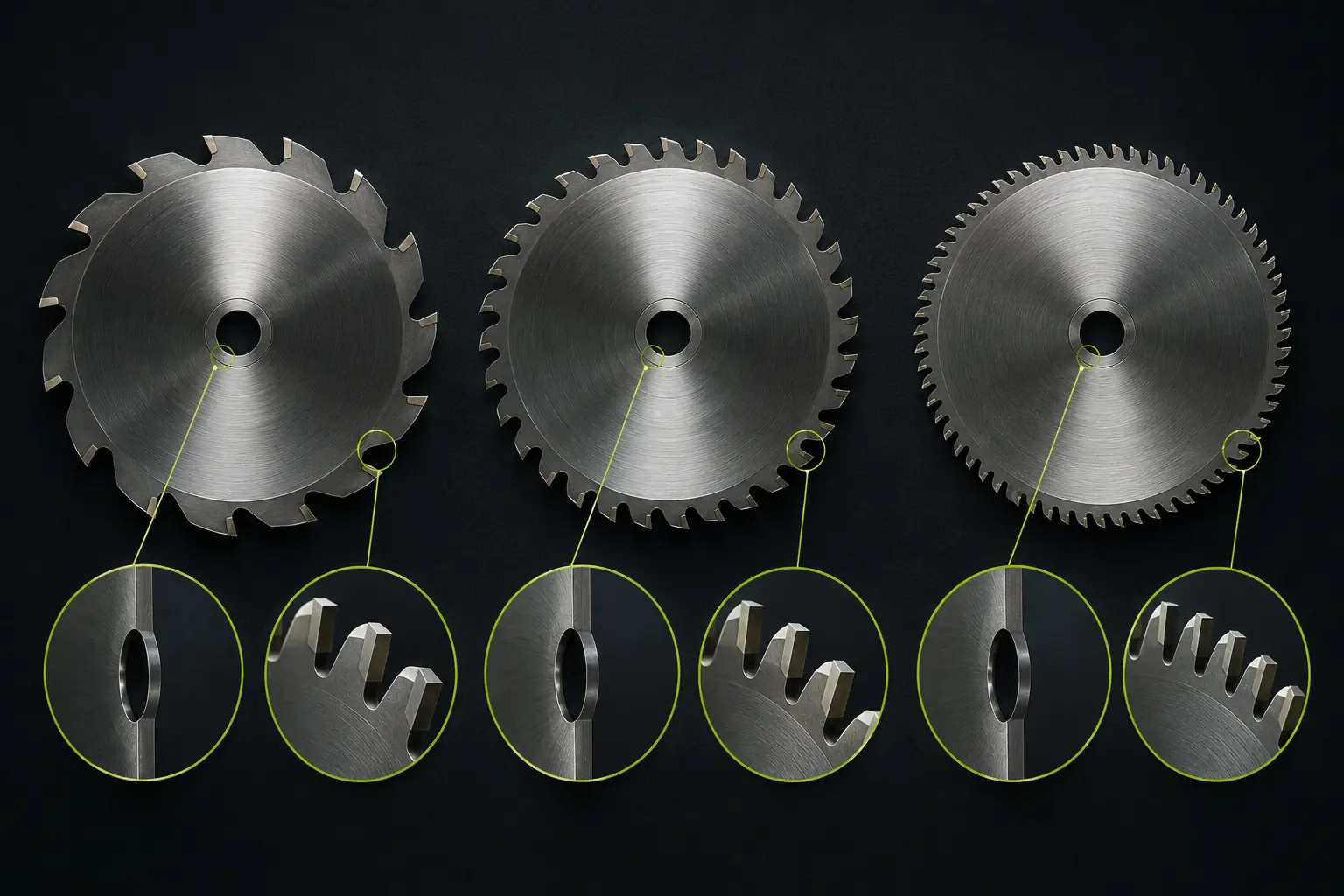
Fit first. Finish second.
Diameter and arbor determine whether the blade can mount. Tooth count and grind influence chip size, feed pressure, heat, and edge quality.
Conceptual instructional graphic · verify the exact saw manualStarting ranges—not universal prescriptions
| Primary job | 10-inch starting range | 12-inch starting range | Priority |
|---|---|---|---|
| Framing crosscuts | 40T class | 60T class | Speed and chip clearance |
| General trim | 60T–80T class | 80T–100T class | Clean edge with practical feed rate |
| Fine crown or visible hardwood | 80T–100T class | 100T–120T class | Low tear-out, with heat and feed-rate control |
| Composite or laminate | Use a material-rated grind and manufacturer guidance | Chip control and heat management | |
These are trade-based selection bands. The blade label and current saw manual remain authoritative for installation and material compatibility.
More teeth are not always better.
Excessive tooth count can increase heat, slow the feed, load with resin, and perform poorly when the blade is dirty or the material requires a different grind.
Never select by tooth count alone.
A blade with the desired finish profile can still be incompatible because of its arbor, maximum RPM, plate thickness, kerf, rotation, brake behavior, or guard clearance.