CONSTRAINT-FIRST COMPARISON
10-inch vs 12-inch
Choose from the cut.
No 2,500-word warm-up. Start with the decision, then inspect the constraints.
CHOOSE 10-INCH IF
You value mobility and blade economics.
Most trim, baseboard, framing, and common crown work fits a capable 10-inch slider.
CHOOSE 12-INCH IF
Capacity is repeatedly the constraint.
Wide dimensional lumber, tall nested crown, and stationary production justify the larger class.
CHOOSE NEITHER IF
Your workload is occasional and narrow.
A compact fixed saw may resolve the work with less weight, footprint, and expense.
SAW-CLASS RESOLVER
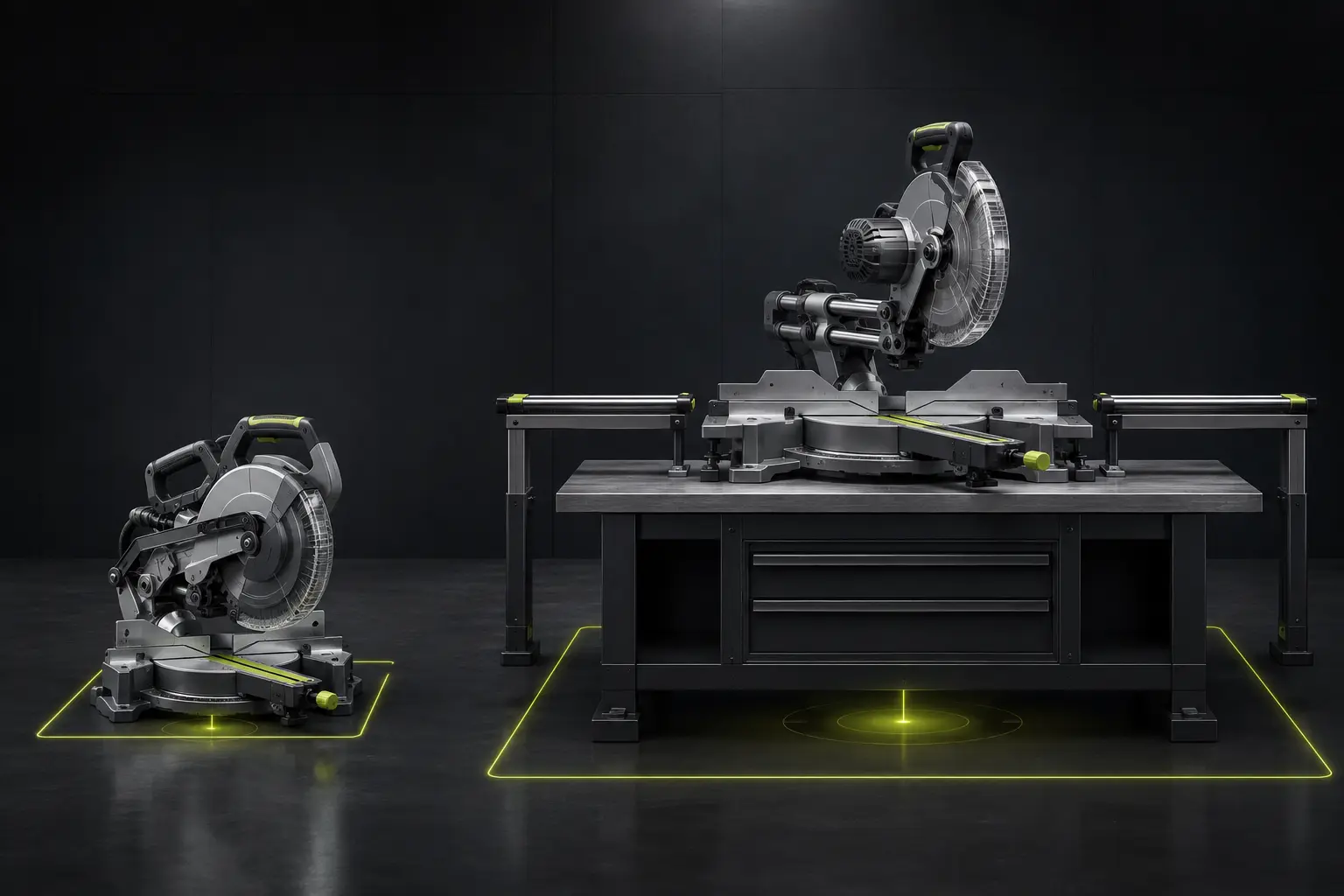
A saw does not have one meaningful score.
Mobility, bench footprint, crown capacity, blade economics, and recurring stock can produce different winners for different buyers.
Conceptual instructional graphic · verify the exact saw manualDecision-complete comparison
| Constraint | 10-inch | 12-inch | Decision |
|---|---|---|---|
| Blade cost | Usually lower | Usually higher | 10-inch for recurring finish-blade replacement |
| Portability | Class can be lighter | Often heavier | Compare actual model weight—not diameter alone |
| Crosscut capacity | Up to roughly 12″ among featured sliders | Up to 14″+ among featured sliders | Run exact stock through the engine |
| Nested crown | Model-dependent, featured range 5.25–6.625″ | Featured range 6.5–7.5″ | Fence height and geometry decide |
| Shop footprint | Not automatically smaller | Glide designs can reduce rear clearance | Mechanism matters more than blade size |