CONSTRAINT-FIRST BUYING GUIDE
Sliding vs Non-Sliding Miter Saw
Sliding wins on width. Non-sliding wins on simplicity, compactness, and often weight.
BOTTOM LINEChoose sliding only when normal stock exceeds the fixed saw’s verified crosscut envelope.
- Start with the cut and workspace constraint—not a popularity ranking.
- Reject any model that fails one hard requirement, even if it scores well elsewhere.
- Verify the current manufacturer manual before buying or cutting.
TRADE-BASED: CHOOSE THIS CLASS IF
Choose sliding only when normal stock exceeds the fixed saw’s verified crosscut envelope.
EXPLICIT EXCLUSION
Neither class wins until the stock width, cut angle, and workspace clearance are known.
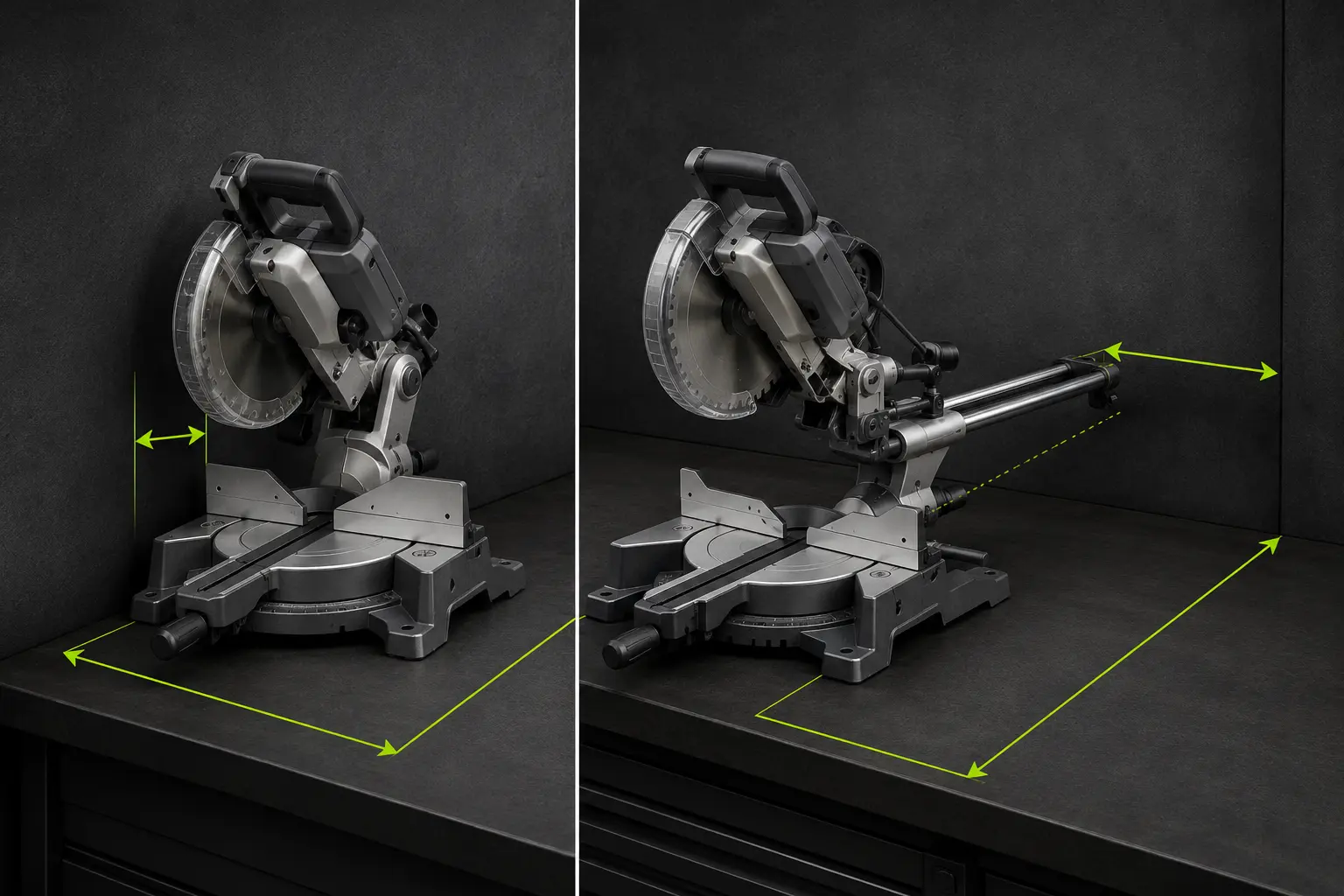
Crosscut reach can consume rear clearance.
A slider may clear wider stock but fail a shallow bench. Forward rails and glide mechanisms change the footprint calculation.
Conceptual instructional graphic · verify the exact saw manualTHE DECISION FUNCTION
Start with the constraints
- 01Stock width
- 02Rear clearance
- 03Deflection control
- 04Weight
- 05Storage depth
Three model records to investigate first
| Model | Blade | 90° crosscut | Nested crown | Weight | Evidence |
|---|---|---|---|---|---|
| DEWALT DWS780 | 12″ | 14″ | 7.5″ | 56 lb | Manufacturer source ↗ |
| Bosch GCM12SD | 12″ | 13.5″ | 6.5″ | 65 lb | Manufacturer source ↗ |
| Makita LS1019L | 10″ | 12″ | 6.625″ | 57.9 lb | Manufacturer source ↗ |
Specifications narrow the field; they do not prove hands-on performance. “Best” remains conditional on the constraints above.