CONSTRAINT-FIRST BUYING GUIDE
Best Miter Saw Stand
The stand must stabilize the saw and support the stock at the same plane—not merely fit the mounting holes.
BOTTOM LINEChoose rolling for heavy stationary-class saws, folding for mobile work, or fixed wings for a shop station.
- Start with the cut and workspace constraint—not a popularity ranking.
- Reject any model that fails one hard requirement, even if it scores well elsewhere.
- Verify the current manufacturer manual before buying or cutting.
TRADE-BASED: CHOOSE THIS CLASS IF
Choose rolling for heavy stationary-class saws, folding for mobile work, or fixed wings for a shop station.
EXPLICIT EXCLUSION
Do not pair a 60-pound saw and long crown with a stand selected only for low shipping weight.
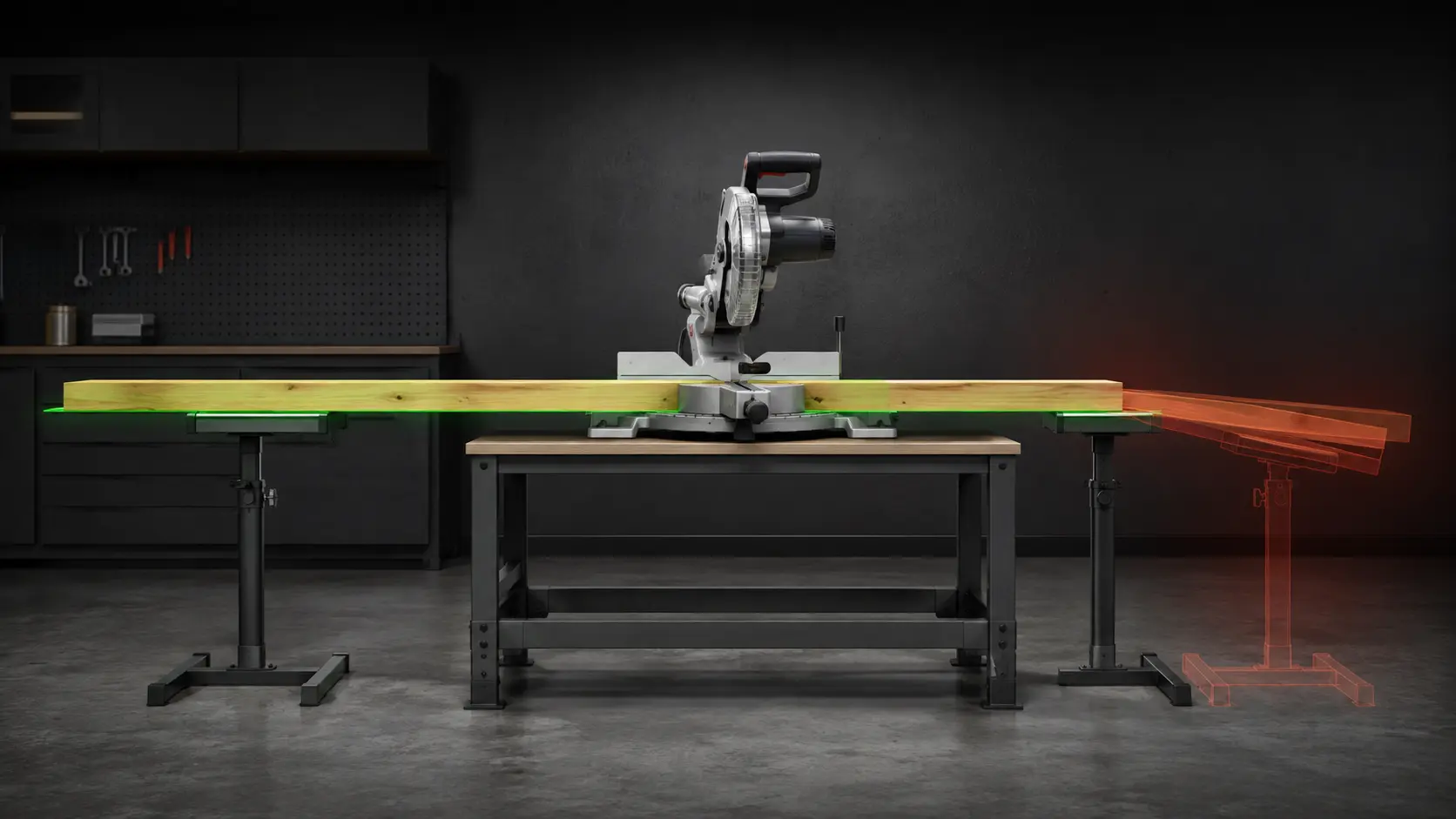
The saw is only one part of the cut.
Support both ends on the table plane, secure the saw, control the offcut, and stop when the workpiece cannot remain stable.
Conceptual instructional graphic · verify the exact saw manualTHE DECISION FUNCTION
Start with the constraints
- 01Saw weight
- 02Material length
- 03Support extension
- 04Wheel geometry
- 05Storage
Three model records to investigate first
| Model | Blade | 90° crosscut | Nested crown | Weight | Evidence |
|---|---|---|---|---|---|
| Bosch GCM12SD | 12″ | 13.5″ | 6.5″ | 65 lb | Manufacturer source ↗ |
| Makita LS1219L | 12″ | 15″ | 8″ | 65 lb | Manufacturer source ↗ |
| Bosch CM10GD | 10″ | 12″ | 6″ | 64 lb | Manufacturer source ↗ |
Specifications narrow the field; they do not prove hands-on performance. “Best” remains conditional on the constraints above.